Friday, March 29, 2013

A Deeper Length of View

Tonight I saw Jack McCoy's highly anticipated surfing film, A Deeper Shade of Blue, his 25th film. Like the last surfing film to hit theaters nationwide, Chasing Mavericks, it had both high notes and low notes and ultimately could have been a lot better (read my review of Chasing Mavericks here). 

Let's get some things straight: Jack is a legend in surfing and surf film making. I love surfing. You'd think then that a documentary about surfing by a surf film legend would appeal to surfers. For parts of the film these planets aligned and it was wonderful. Unfortunately, the biggest drawback of the film was that it seemed completely devoid of any editing that could have made the movie flow. 

At least 45 minutes of A Deeper Shade of Blue should have been left on the cutting room floor. There is a a LOT of superfluous material that would be mildly interesting on a bonus DVD disc. For starters, the first 15-20 minutes is a panel discussion between McCoy and some of the movie's subjects with lots of rambling on about the inspiration behind the film and how it came together. I'm no film expert but I'm not aware of the practice of starting a film by talking about the film. Suddenly, Manoa Drollet, a Tahitian surfer, joins the panel and when he starts talking about something interesting, namely managing/surviving a wipeout at Teahupoo, he gets cut off and the segment abruptly ends. 

The premise of the movie, as I understand it, is to highlight a handful of surfers around the world who make surfing special in their own special way. They all use different surf craft but they're all super stoked on surfing and therefore make defining surfing impossible. These portions of the film are terrific. I loved watching and learning about incredible surfers like Jamie O'Brien, Chad and Trace Marshall, Derek Hynd, and Terry Chung. But it's WAY too long before we get to the first subject. This is unfortunate because these are stars of the film. Let's get to know these guys and see what they do! 

Unfortunately, these segments are broken up by an evolutionary history of surfing and board design. If you want to make a movie about surf history, fine. Surfboard evolution? Fine. But to combine these, assuming a lowest common denominator with your audience and interspersing it with segments of Manoa Drollet at Teahupoo and Marty Paradisis at Shipstern's Bluff and Terry Chung foil boarding in Kauai makes for a jumbled mess. Where was the editor?! The history segments weren't helped by the fact that the writing and narration were in a style that left me wondering if I was at the Polynesian Cultural Center and not a theater filled with surfers who already know this stuff. As the saying goes, "know your audience."

That said, the historical footage of Barry Kanaiaupuni, Wayne Lynch, and George Greenough among others were all great. Before tonight I had mostly seen only still photos of these legends which obviously doesn't come close to capturing their brilliance. A Deeper Shade of Blue really hits its stride when we get to Jack's underwater cinematography. It's both gorgeous and innovative but we don't get enough of it. It's not until after the closing credits do we see some of his best underwater footage that's further highlighted by a great new song from Paul McCartney called Blue Sway. Why leave this phenomenal stuff for the very, VERY end, when several people have already left the theater? And this wasn't even the end of the movie! McCoy goes back to his informal panel discussion and we hear these guys drone on and on about nothing in particular. I literally couldn't stand it any longer and had to leave, exhausted by the two-plus hours of disorganization. Again, where was the editor?!

Let's end on a high note. As a father to two girls, I loved the women's segment. Like McCoy's underwater footage, the women's segment was beautiful and aspiring. I found it fascinating to hear how much of an impact Kathy Kohner, aka Gidget had on Stephanie Gilmore, one of the world's best female surfers. Her revere for Gidget contrasts sharply with the broader surfing community as most surfers equate Gidget with the death knell for the golden age of surfing by bring the masses to our coasts, shores and waves.

In closing, I'd like to have this movie for my collection however a remote with functioning fast forward button will be absolutely critical as this movie was about twice as long as it should have been. 


Until next time, may your waves be head high and glassy.

Monday, March 18, 2013

The Allure of the Not-So-Secret Spot

I get to surf once a week, usually a Saturday or Sunday, the same two days most of humanity comes out to surf. To make matters worse, humanity seems to converge on the same few spots and this makes for a really crowded, frustrating experience. If I want to sit in a sea of humanity and get really frustrated on a day off, I can do that at the DMV or the mall. I never look forward to going to those places. Why would it be any different on a surfboard? I want to look forward to going surfing. 

It's because of this that I find myself going to spots humanity doesn't care to surf. They aren't secret spots by any means. They're just off the beaten track. You can't check them from the highway. There are no webcams showing you the conditions. They're more fickle and therefore less popular. They aren't spots you go to be seen, to be noticed, to be cool. Instead these are the spots you go to be alone with your thoughts. You go to get in the water and wash off all the crap that accumulates in your life while on land. Sure, the waves may be smaller, mushier or close out more often. The beach may be harder to get to and the lull between sets may be longer once you get there. But these spots are also less crowded. You can let waves go by. You can try new moves. Work on fundamentals. Be a kook. You can do all of these things at a crowded spot but humanity will notice. Humanity will drop in on you, snake you, spray you and all around disrepect you. Not my idea of a good time.

Don't get me wrong. I wish I was more patient or more aggressive. I wish I could sit in the pit, exert my place in the hierarchy, terrorize groms, all the stuff that established locals do. But I'm not so I don't. And I'm okay with that. I'm happier with the peace and quiet I get sitting at an empty break. The thrill of riding a wave seems more pure, more special, more thrilling. And because you don’t have to compete for waves, you can feel that thrill more often. In my book, more waves means more fun.

So don't be a snob. Spend more time searching for a surf spot and less time searching for a parking spot once you get there. There's fun to be had off the beaten track, at a not so secret spot that isn't hard to find. Go!

Until next time, may your waves be head high and glassy.
Wednesday, March 13, 2013

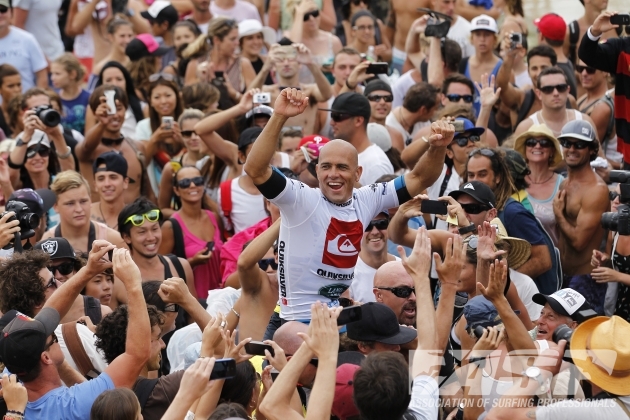
Kelly Kills it at Kirra


KS has done it again. Yesterday he won the Quik Gold Pro at Kirra on the Gold Coast of Australia. His 52nd ASP event win. He beat Joel Parkinson, last year's ASP world champion, a native Aussie, at his home break, in less than optimal surf (while the final had lots of barrels, the conditions for most of the contest were terrible). In fact, he beat Mick Fanning, another local, to face Parko in the final. Ultimately, he continues to defy the odds. Some things to ponder:
  • He's twice as old as many of his competitors.
  • He doesn't have to prove anything to anyone anymore - he's already the winningest professional surfer and athlete in all of sports.
  • Many/most in the surfing community expected him to announce this would be his last season on tour, making the season nothing more than a farewell tour.
  • He has a family, friends all over the world and a business venture - all things that can and should require more of his time and energy or at least make retiring an easier decision.
  • He held his own in the expression session earlier in the week, a no-holds barred, free surf where the most radical moves are called for. Think lots of aerials with, again, competitors half his age.
  • He advanced to the final in crappy surf despite having the opportunity, resources and practice of surfing flawless waves at the peak of a swell all over the world.


How does he do it? How does he stay motivated? How does he stay healthy? How does he stay inspired? I don't think he uses PEDs (he says he doesn't and doesn't believe they would make anyone surf better). And while I've never seen him bleed, I'm confident he isn't a robot or software program. He is simply amazing. On top of that, he seems very humble and nice and a great ambassador to the sport and lifestyle.

I'm officially pulling for him to win his 12th world title this year and I wish him years more of competitive success and happiness. He is truly an inspiration to me and countless other surfers all over the world. Congratulations Kelly. Go get 'em in '13.

Until next time may your waves be head high and glassy.

Tuesday, February 26, 2013

Build a Board, Break a Board

It was the best of times, it was the worst of times. It was the age of wisdom, it was the age of foolishness. It was the...okay, you get the point. Christ, Dickens, were readers that dense a hundred and fifty years ago?


Regardless, this dead horse beating is meant to demonstrate that I had a roller coaster of a weekend. On the one hand, I finished shaping my first surfboard. It took years, yes years, to shape. Afraid of messing up, quick to put it aside to focus on easier things, not having the right tools and a whole bunch of other excuses all made it easy to put off. Well, I finally got tired of looking at yet another project I'd started and not finished. I also realized I'd never get any good at shaping if I didn't actually shape. So I did it. Once I glass it (hopefully this part won't take 2-3 more years), I'll be really anxious to take it out and see how it works. My expectations are low but, it's a big accomplishment just the same. As a result, I got a lot of kudos and back slaps from friends and family on Saturday. Most importantly, I can now say that I am a shaper. Not a dreamer. Not a wannabe shaper. A shaper. Safe to say, I was pretty proud of myself.


Well, I guess the surf gods didn't want me to get a big head. I went surfing on Sunday and took one of my favorite boards, my 9'6" Pearson Arrow longboard. I've had it for years and it surfs great in all conditions (you can read more about this special board here). Unfortunately, the conditions were terrible on Sunday. Waves were doubling up and, when I did catch one, I had to contend with the backwash. Needless to say, decent waves were hard to come by. When I had finally had enough of not catching waves, I started moving closer to shore, hoping to catch one last wave. The waves further inside were steeper but also breaking in shallower water. I got what I wanted. I caught a wave but even with over nine feet of rail, the board never bit into the wave. Instead, it went straight down. When I surfaced, I had a bad feeling. When I swam over to to my board and flipped it over, my fears were almost realized. It didn't snap but the impact shattered, peeled and delammed the glass as well as broke one of the stringers. While I enjoy doing doing repair, this is going to be a lot of work.


If there's a silver lining in this, it's that I have a great excuse to shape another board.

Until next time, may your waves be head high and glassy (and not in 12 inches of water).

Sunday, February 10, 2013

Making Jay


Because there aren’t a lot of fictional surf movies made (and given the quality and authenticity of those films, that’s a good thing), surfers probably spend more time thinking and talking about the ones that have been made than they should. Such is the case with last Fall’s Chasing Mavericks. While it was better than the tin standard, Point Break (read my review here), it had its flaws. But most movies do.

As I was already pretty familiar with Jay Moriarity’s story, I was most intrigued by Frosty Hesson, Jay’s coach and mentor. Here was a guy who charged Maverick’s and, despite the bravado and life threatening repercussions associated with surfing this wave, took Jay under his wing and taught him how to ride it. That’s why when my friend Greg Cochran, President of the Pedro Point Surf Club, mentioned that Frosty had written a book following the release of the movie, I put it on my Christmas wish list.

Part autobiography, part Jay biography, and part coaching/life manual, Making Mavericks is a fascinating look into the life of an underground surfing legend. From an early age, Frosty was drawn to water and strove to be proficient in it, first with swimming, then water polo, then skiing and finally surfing. Frosty prospered in these sports but had to figure things out primarily on his own. He recognized that quality coaching was critical to success and growth and dedicated a lot of his free time to coaching kids, first with Bob Pearson’s surf team, then the Soquel High School surf team. When Jay approached Frosty, it was with the wish to be a better surfer. Jay’s request was simple but pure. Frosty admired that and showed Jay the way. To Jay’s credit, he provided the perseverance and work ethic. Frosty admired that too. When Jay wanted to be an effective contest surfer, Frosty helped him achieve that goal too. Again, with a lot of hard work, Jay accomplished his goal. Then, at only 15, Jay approached Frosty with a real challenge: teach him to surf Maverick’s.


The book features many takeaways that are bolded for emphasis to reinforce the lessons Frosty learned through his experiences and imparts on Jay. Some samples include:
  • Have a vision.
  • To become a capable, competent individual, learn from capable, competent individuals.
  • Don’t give less than it is your right for you to give.
  • You have to break down every goal into smaller, achievable steps, and acknowledge accomplishing each of them.
  • When you’re experimenting and trying to learn, you’re going to fall – when you stop falling, you start stagnating.
  • It’s easy to make a good athlete. It’s very hard to make a good human being.
  • To be successful, you cannot let yourself be tainted by other people’s fears.

Having grown up in the Bay Area, it was a treat reading about Frosty’s upbringing. He was raised in Hayward and lived in Lake Tahoe and Santa Cruz. His surfing exploits took him to the North Shore of Oahu, the East and West sides of Santa Cruz and, of course, Maverick’s. You’d have to be living under a rock not to know that Maverick’s is a special place and the surfers who charge it are special people. I especially enjoyed Frosty’s retelling of his first paddle-out at Maverick’s in October of 1998:

I saw Jeff [Clark] start to paddle and he was paddling harder and faster than anyone I’d ever seen. As he started his paddling, the bottom of the wave slope had not touched him yet. A few seconds later, the bottom of the slope touched him, and he went backward. He kept paddling at this furious pace, so intent and so focused, and I could not fathom how he went backward up the face of a wave. My heart started to pounding in a rush of excitement and fear—this was obviously a totally legit huge wave and it as where I lived! The whole world had suddenly changed. At the same time, I had to focus and put aside my emotions. It didn’t matter how awesome it was to have these waves in my backyard if I couldn’t ride them. So rather than get caught up in the thrill of the discovery, I started watching and turned it into an analytical process. There was only on question on my mind: how do I ride this wave?

Ultimately, Making Mavericks is much more than a book about a guy teaching a hyper-focused kid how to surf big waves. Instead, it’s a retrospective of a man preparing a boy for manhood while at the same time learning what manhood is all about. Frosty doesn’t pretend to have all the answers. When he was a kid he was just like Jay – an energetic kid thirsty for knowledge. But unlike Jay, Frosty had to figure things out on his own. Frosty sees Jay’s passion for learning and setting/meeting goals but knows kids can’t lean life’s lessons all on their own. He takes Jay under his wing and the rest is history. Frosty clearly has a soft spot for Jay and Jay clearly reveres Frosty. We get a glimpse into that symbiotic relationship and this element of the story really shines in the book.

In all, I found Making Mavericks a great book for two reasons: it provided me with a glimpse of the special relationship Frosty had with Jay and it provided many important lessons Frosty acquired through life that I can apply to my own life, to make me a better person. I highly recommend this book.

Until then, may your waves be head high and glassy.

Sunday, December 23, 2012

Twas the Night Before a Hawaiian Christmas


Twas the night before Christmas, and all through the hale
Not a creature was stirring, not even Ray Kane.
The stockings were hung inside our beach shack with care,
In hopes that Uncle Nick soon would be there.

The keikis were nestled all snug in their beds,
While visions of kalua pig danced in their heads.
And mommi in her mumu, and I in my trunks,
Had just settled in to sleep in our bunk.

When out on the beach there arose such a clattah,
I sprang from my bed and said, “eh who dat, bruddah?”
Away to the window I flew like a flash,
I tore open the shutters and almost knocked over my stash.

As the moon brightened the black volcanic sand
I knew right away there was magic at hand
When, what to my wondering eyes should appear,
Shoots! It was a big red sleigh, and eight tiny reindeer!

With a little old driver, all nimble and quick,
I knew right away, “eh, dat’s Uncle Nick!
All wikiwiki his reindeers they came,
Santa hooted all loud and called ‘em by name!

"Now Buff! now, Rabbit! now, Jose and Kimo!
On, Gerry! On, Buttons! on, Clyde and Reno!
To da top of da hut! to da top of da wall!
Now dash away! Dash away! Dash away all!"

Like palm leaves in the trade winds, eh watch ‘em fly,
They swirl round and round in the clear North Shore sky.
So up to the roof the reindeer they flew,
With a sleigh full of toys, and Santa Claus too.

And then, in a twinkling, I heard on the roof
The shuffling of each big wave chargers hooves.
As I pulled in my head, and spun right around,
Down the chimney Uncle Nick came with a bound.

He was sporting black slippahs and a colorful aloha shirt,
But his clothes were covered with sand and red dirt.
A sack of goodies was slung on his back,
And he looked kinda like a beach bum, living out of his pack.

Oh but his eyes, man did they twinkle! And his dimples they were so merry!
His cheeks were like roses and his nose as red as Rudy’s!
His smile was brighter than a rainbow,
And his beard as white as haleakala snow.

He loved cherry shave ice, you could tell by his teeth,
For when he smiled at me, his gums were as red as a beet
He had a broad face and a serious beer belly,
That shook when he laughed, like, well, a belly full of beer!

He was chubby and plump, a right jolly old dude,
And I laughed when I saw him, and offered him some food.
A wink of his eye and a twist of his head,
Soon told me he was looking for a beer instead.

I handed him a Primo and he went straight to his work,
He filled all the stockings, then shot me a smirk.
He threw me a shaka and pointed to the tree
As he rose up the chimney I saw what he’d left for me

He sprang to his sleigh while I gave my new board a hug
And his reindeer took off with just a simple tug.
But I heard him shout, as he flew outta sight,
"Mele Kalikimaka to all, and to all, a-lo-HA!"


Merry Christmas, Happy New Year and may all your waves be head high and glassy.


Friday, December 14, 2012

North Shore Chronicled


How fitting that I would find a copy of Bruce Jenkins’ North Shore Chronicles in a used book store the day before the start of the Vans Triple Crown. Bruce is a local sports writer here in the Bay Area and while he usually writes about more mainstream sports, I have always enjoyed reading his columns on surfing. I had heard about this book for years and knew he was a big fan of surfing so buying the book was a no-brainer.
 
A word about surfing books. It’s difficult to capture the thrill, danger, and essence of surfing with the printed word. It makes sense though if you think about it. After all, if Hollywood can’t do it with lots of cameras and big budgets (see my recent blog on Chasing Mavericks), how can we expect writers to do it? This task is even harder when writing about big waves simply because it’s hard to visualize a 40 foot wave and how it seems small when compared to a 60 foot wave. It’s even harder when waves are measured Hawaiian style (Hawaiian wave height references the swell height or back of the wave, as opposed to the face of a wave, so a 30 foot wave by Hawaiian standards is closer to 50-60 feet on the face).

That said, the strength in surfing books is usually in the portrayal of the characters riding the waves more than the waves themselves. Not surprisingly, there are lots of characters on the North Shore and Jenkins does a great job introducing them to readers and highlighting their achievements. In fact, each of the book’s chapters focuses on a highly regarded surfer. At the time North Shore Chronicles was published (in 1990) Jenkins had been making an annual trek to the North Shore for almost 15 years. In that time, he had been able to identify, study and really get to know a number of big wave chargers during the 70s and 80s. Not surprisingly, there are some familiar names in the book like Ken Bradshaw, Darrick Doerner, Mark Cunningham, and Mike Stewart but also some other surfers I had never heard of like Trevor Sifton and Tom Nellis. I thoroughly enjoyed learning about all of these surfers.

I found it a little spooky reading about Mark Foo. How was Jenkins to know that just four years after his book was published, Foo would drown on a relatively benign wave at Maverick’s? Foo’s personality was as big as the waves he rode and it rubbed a lot of people the wrong way, especially in a surfing community that prefers to let surfing do the talking. But I get it. It takes a special breed to want to ride big waves and, more importantly, ride them well.

When you paddle out there, you look at guys’ faces, into their eyes, and you can tell who really loves it. It’s just a select few that have that look, and the discipline to stay put when it really gets heavy. I mean, the horizon just blacks out. You’ll see the outer reefs go off outside Logs or Alligators, and it just goes black. It’s coming. And you know exactly where. Guys are running and hiding, scrambling all around. If you really want it, you just stay right on that boil.

But things aren’t always what they seem. Despite Foo’s bravado, he wasn’t a daredevil, which creates an interesting paradox or intriguing psychological look into an action sports star.

For me, the more adverse the situation, the more peaceful I am. That’s when I become truly centered. It’s really funny. Basically I’m kind of high-strung and nervous. I’m scared of speed, I’m scared of heights, I don’t gamble. I’m not really into athletics. Surfing big waves is the combination of all these things that are against my nature. That’s why I feel there’s a bigger purpose to it.

Another development since Jenkins’ book was published was the rise of women’s surfing. In the late 80s, Jenkins had observed that the women’s movement had stalled, the professional circuit had been left for dead since 1983, there were no women charging big Hawaiian surf and bodyboarding was likely to be the saving grace for ocean-loving women in Hawaii. Thankfully, women’s surfing is stronger today than ever before. Longboarding reemerged with Daize Shayne Goodwin and Kassia Meador. High performance and professional surfing is loaded with talent, including Coco Ho, Stephanie Gilmore, Sally Fitzgibbons, and many, many more. And big wave surfing, Jenkins’ biggest concern, is proudly represented by Keala Kennelly, Maya Gabeira, and Sarah Gerhardt charging hell waves like Jaws, Teahupoo, and Mavericks. In a nutshell, women’s surfing today is healthy and here to stay.

Other highlights of the book are the chapters on Ken Bradshaw and Darrick Doerner. Laird Hamilton has gotten the lion’s share of press and limelight when it comes to Hawaiian big wave surfing but it’s important to see that there are other legends out there who are just as deserving of recognition and admiration. In addition, Jenkins’ review of Eddie Aikau and the contest at Waimea Bay that bears his name makes for great reading. The 1990 event is featured as, according to chief judge Jack Shipley, featured some of the cleanest conditions in the event’s history. The competitors also noted how unique this contest was.

Mark Foo described the day [January 21, 1990] as “all time epic.” Richard Schmidt put it in his “top three” over the last 10 years. Darric Doerner said it reminded him of a day when he surfed 15-18-foot Laniakea with Wayne Lynch in howling offshores, “tubes so big you could build a house in both directions,” and a level of excitement so great, he was hoarse from yelling. Personally, I felt a sense of privilege to be on the beach.

The 29-year-old [Richard] Schmidt had been smoking-hot all winter, winning the Hawaiian pro contest at 15-foot Sunset and finishing third in the Triple Crown’s Hard Rock event. “When I saw that set feathering on the horizon, I started talking myself into doing it,” he said. “Usually I’m 100 percent positive, but this wave was at least 25 feet, and at that size, your survival instinct tells you to paddle over it. Maybe you don’t want this. But with the contest on, and the crowd and all that, I figured I’d just go for it.

As soon as Schmidt got to his feet, the wave sucked out underneath him and he was pitched into the air. He dropped a good 10 feet through open space. “On a glassy day, my board would have just dropped away,” he said. “But the wind kept it right underneath me. I felt like I was just floating – and then I landed.”


In a spectacular display of balance and positive thinking, Schmidt was still in the wave. He got to the bottom, turned and rode it out. “I was so ecstatic,” he said. “That was probably the heaviest wave of my life. It was the epitome of big-wave riding – putting yourself at the most critical point, on the biggest wave, and coming out unscathed. I was just shaking with adrenalin.”

Again, surfing books struggle to capture the essence of surfing, particularly big wave surfing. Jenkins’ book does not have this problem. I recommend it highly.

Until next time, may your waves be head high and glassy.